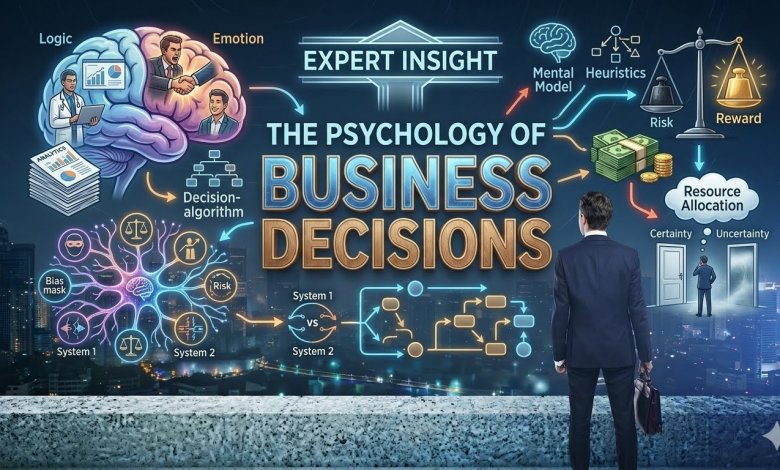
Throughout the work we do with our entrepreneurs and leaders, there’s one underlying constant: the impact that psychology has on business decision making. Far from the sterile world of spreadsheets and data tables, a range of human psychological influences and pitfalls actually drive many of the business decisions that are made – in many instances, entirely unbeknownst to decision makers. Bringing awareness to these cognitive patterns helps leaders make clearer, more considered choices than those of the automatic, mental traps we all fall into.
The psychology of how business decisions get made:
The Illusion of Pure Rationality
Even the most logically constructed arguments can fall prey to the irrational human nature of decision makers.
Humans are not logical processors.
We may think we are, but all data and decision makers can fall victim to cognitive shortcut and emotional decision biases.
As experienced as we are with the executives we coach, one of the first things we’re tasked to help with is awareness that nobody’s decision making, not yours nor anyone else’s, is purely “rational.”
Loss aversion and risk-taking
The negative effect of loss on human emotion and physiology is roughly two times greater than that of gain.
In many instances, the risk aversion associated with losing money acts as a stronger motivation in business decisions than the potential for gain. This often leads to caution on projects and a hesitation to seize opportunity due to fear.
The Sunk Cost Fallacy
This one is particularly pervasive. When we start a project and invest time, money, or other resources into it, we can develop an emotional attachment. This isn’t necessarily tied to the overall health of the business or the ultimate goal, but instead it can become about not wanting the “sunk cost” to feel wasted. It can be very difficult for even sharp business leaders to ‘pull the plug’ on a failing venture when so much has already gone into it, as doing so feels like an acknowledgment of failure.
The Anchoring Bias in Negotiation
The term can refer to the initial number presented (i.e., first offered sale price) in a negotiation. Anchoring is an unconscious psychological process.
In negotiations, the anchoring point is one where it is difficult for one of the parties to diverge too far away. Anchors can have a huge, often disproportionate impact on the direction of the business negotiations.
Confirmation Bias
In this psychological tendency, people favor evidence and information that confirm their existing beliefs or hypothesis, and disregard evidence that does not fit their current point of view. When we are personally invested in a certain decision, we tend to ‘see’ data that supports it more readily.

Groupthink
This refers to a psychological phenomenon where the members of a group become more focused on maintaining team cohesion than on realistically appraising the alternative options or decisions available to them.
The urge to conform to the perceived consensus within a group may silence dissenters or prevent them from vocalizing their concerns, leading to flawed business decision making.
Over-confidence in forecasting
Leaders of companies, particularly successful one’s often over-emphasize their forecasting skills and underestimate the probability of risks within specific strategies or markets. This often leads them to make big decisions with confidence and minimal foresight regarding the real potential downside risks.
Emotional state influence
We’re all humans and as you can imagine, things like stress, lack of sleep, and high levels of emotion affect decision-making skills. Leaders under significant pressure may over-react to events or may be much more risk-averse, hampering smart decision-making.
Social Proof in business
It’s common in business for leaders to feel the need to “follow the pack” or engage in practices “just because that’s what everyone else is doing.”
Social proof is the heuristic that in most cases, other people’s behavior will be appropriate in a given situation and it will usually guide their decision making.
Making Better Decisions
Bringing awareness to the psychological influences at play within decision making processes isn’t going to instantly “cure” all bias or emotional impact. However, the right coaching and some structured techniques (like a 3D business decision perspective)

can help leaders develop better decision-making skills that are less prone to the pitfalls we’ve described here.
Thanks