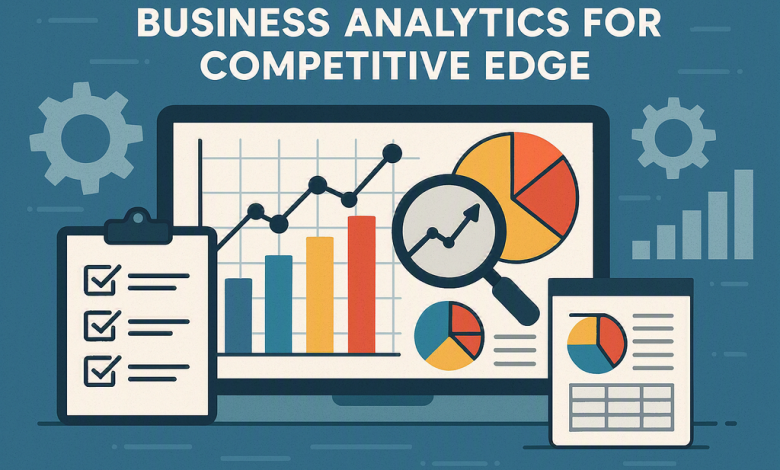
Today, business just doesn’t run on guts; to succeed in this highly competitive marketplace you have to be sharp, you have to be smart and you have to know how to leverage business analytics to your company’s advantage – from understanding your customer purchasing behavior to streamlining your internal operations and beyond. The most cutting-edge businesses utilize business analytics as part of their secret sauce for a number of reasons.
Why Is Business Analytics Important
Business analytics takes raw data and converts it into usable insights for a business; this insight helps you understand how everything from your operation’s workflow to your position in the market is faring.
Some of the key ways that business analytics can be leveraged to benefit your company include informed decision-making, where analytics helps companies to make business decisions and remove guessing and intuition out of the picture. Early trend identification allows companies to identify market trends and patterns before competitors do. Increased efficiency helps identify how money and time are wasted and can suggest potential savings. And improved risk management means the predictions offered by analytics can allow a business to anticipate risks and hazards that might come their way.
Business Analytics Can Be Broken Down Into Four Types
Descriptive analytics answers “what happened in the past?” It is the practice of collecting and interpreting historical data to determine how business has performed in the past.
Diagnostic analytics answers “why did it happen in the past?” It goes further than merely assessing performance; instead it investigates and analyzes historical events to uncover the root cause as to why it occurred.
Predictive analytics answers “what is likely to happen in the future?” It utilizes statistical models to estimate future business outcomes.
Prescriptive analytics answers “what should a business do about future trends?” This is the highest form of business analytics; prescriptive analytics focuses on suggesting recommended courses of action based on predictive analytics and historical performance to arrive at desired future outcomes.
Understand Customer Behavior
Businesses can gain incredibly detailed insights about who their customers are and how they’re engaging with their company.

Purchase pattern analysis involves understanding the typical process customers take before purchasing a product or service, which can help you understand them better for the next step of engagement. Customer segmentation clusters groups of customers together based on common traits such as purchasing behavior or preferences. Sentiment analysis gauges what customers, both those who buy and those who don’t, really feel about your brand and products based on online reviews, conversations and social media engagement. And personalization opportunities emerge once you know your customers inside-out, so you can start personalizing communications and offers for an improved experience, and higher conversions.
Optimize Operations With Data
As impressive as front-end data can be, there are also countless benefits to looking at business analytics for internal processes.
Supply chain optimization involves examining how data related to supply chain flow, lead times and supplier activity can be leveraged to cut costs and increase efficiencies. Workforce analytics draws insights from examining employee behavior, work rates and trends, which can lead to improvements in employee productivity and recruitment decisions. Cost analysis tracks resources allocated throughout an organization to help identify areas of excess expenditure, resulting in significant cost savings and improved allocation. And process automation insights can pinpoint opportunities to automate repetitive and time-consuming processes, freeing up human resources to focus on more strategic work.
Competitive Benchmarking
It’s crucial to have a grasp of how your organization stacks up against competitors.
Market share analysis helps you understand how much of the overall market share you hold to identify growth potential and areas where competitors may be excelling. Pricing strategy insights come from analyzing competitive pricing and how it impacts customer behavior, which can help you develop the most strategic price for your products or services. Product performance comparisons let you see how similar products are performing in the market and make informed decisions about how to improve or adapt your offerings. And industry trend tracking helps you keep an eye on the latest developments and shifts occurring within your industry.
Tools and Technologies for Business Analytics
In the practice of business analytics, various tools have made the data analysis process far more seamless and powerful. These include Business Intelligence (BI) platforms which help integrate, cleanse and process data so it is ready for reporting and analysis; Artificial Intelligence (AI) and Machine Learning (ML) algorithms which are increasingly incorporated into business analytics for advanced predictive and prescriptive functionalities; cloud-based analytics solutions which facilitate processing and management of large data sets rapidly; and data visualization tools that present data in easily digestible charts, graphs, and reports to illustrate key findings and trends.
Building a Data-Driven Culture
The tools alone will not transform your business into an analytics-powered entity – an organization needs to build and maintain an environment where data-driven decision-making becomes the norm.
Leadership buy-in matters: if data-driven decision-making is to become a cornerstone of the business, then senior management must actively champion the process and ensure that employees feel empowered to make such decisions. Employee training is essential, since employees at every level of the organization must be trained to competently understand and use data to drive their actions. Cross-departmental data sharing requires organizations to break down data silos and encourage collaboration across departments to facilitate a comprehensive and holistic view of business operations.

And continuous evaluation is essential for companies to continually assess and improve their business analytics strategies and processes.
Thanks